

What was known
- The manor house is standing, and it is being restored
- The oldest known description of the buildings — the 1793 deed dividing the estate
What was missing
- Who owned the village and how it passed from hand to hand
- Who lived in the village and what they did
- What is known about the church
- Where to start: 18th-century court books in Polish, without any index
How Nyshporka searched
Read the whole fond
Any page could mention the village, so Nyshporka read all 146 Kyiv castle court (grod) books for 1750–1796 — 111 824 pages of Polish cursive script.
Find every mention
The machine reads the village name however it pleases: «zaropowii», «Jasopowiecka». A search that allows for errors found 676 mentions of the village and 2 432 mentions of its owners' family.
Sift out the rest
Similar names — Karpivtsi, Harapivka, Jarowiec — were checked and rejected: 2 054 false hits. No match goes into the report without its context being checked.
Bring it into one story
Everything found was sorted by topic and into a timeline for 1747–1796 — with fragments of the manuscript, transcriptions and translations.
Owners over half a century
- 1750–1777
Kajetan Rościszewski — master of the hunt, later a priest and dean of Kyiv. The village belongs to the Khodorkiv estate group; in 1758 the court bailiff finds him in Yaropovychi in person.
- 1777
The estate group is sold to Prince Adam Poniński. Then come years of disputes among the dean's heirs.
- 1782
On 19 June, in Zhytomyr, the village is bought by Michał Trzeciak. From 1785 he is castellan of Ovruch; he is buried at the Dominicans' in Khodorkiv.
- 1790–1793
Trzeciak's five sons divide the estate into shares. In 1794 Karol's share is handed over to the Protasowicz family for a debt, and in 1795 Leon's share to the Zhytomyr mission.
- 1796
The last trace in the fond is a register line dated 29 August: the conveyance of Yaropovychi and Karchmyska to the Hulewicz family. After that the village's history continues in other fonds.
The manor house: a summons laid on the table

No book describes the manor before 1793. But there is a formula the court bailiff had to follow to the letter: the summons had to be laid in a living room of the manor. And in Yaropovychi he writes: “in the manor there, in the parlour, on the table”.

- How the machine read it
- Homn Subett od nicrd do dobr Mzi zaropowii / yłam ten Pozaw ue ducrze tanscygszym w gebie nia
- How it is actually written
- …do Dobr Wsi Jaropowiec y tam ten Pozew we Dworze tamejszym w Izbie na stole położył…
- In English
- …to the estate of the village of Yaropovychi, and there laid that summons in the manor there, in the parlour, on the table…
Nyshporka found the same formula in books spanning almost four decades — from 1751 to 1789. So a lived-in manor with a parlour stood in Yaropovychi from 1751 at the latest — 42 years before the first description of the manor house.
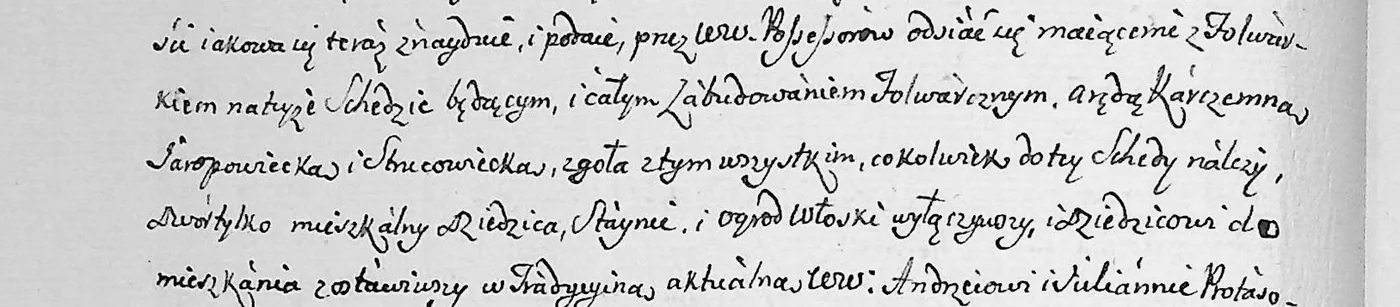
- How the machine read it
- Dwortyko miesszatny Sziedzica, Saymi, i ognodWtoski wyłąregiony, iaziedzicowi do
- How it is actually written
- Dwór tylko mieszkalny Dziedzica, Staynię, i Ogród Włoski wyłączywszy, i Dziedzicowi do mieszkania zostawiwszy
- In English
- …excepting only the owner's residential manor, the stable and the Italian garden, and leaving them to the owner to live in…
The Italian garden, the brewery and the stable are mentioned as early as 1782–1783. In 1794, when part of the estate was handed over to creditors, the manor, the stable and the garden were left to the owner “so that he had somewhere to live”.
The church on Srokova Hill
The first mention is an unhappy one: in 1752 a thief broke the church door open with a knife and stole four strings of coral from the icon of the Mother of God.
In 1776 the owner gave the parish priest an endowment charter, and the church began to go up on Srokova Hill: “in a lonely, wild place, far from the village”. The villagers had already prepared timber for the old site in the village and had even hired a master builder for two hundred zloty to move the church back.
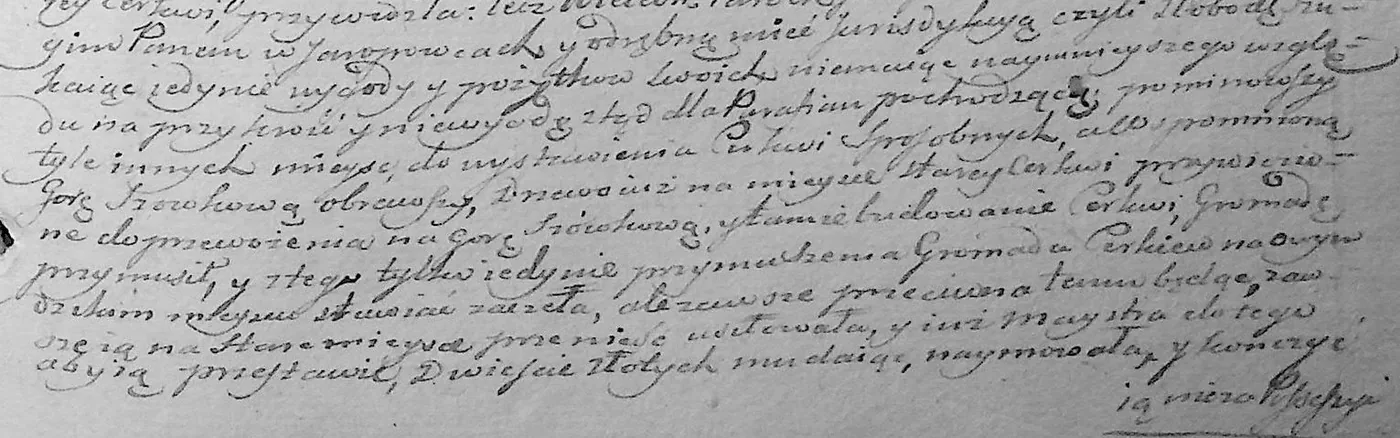
- How the machine read it
- ne doprseworenia na Gorę Siowtwwa, y tumie tuilowanie erkwi Iwmese
- How it is actually written
- …na Gorę Srokową, y tamże budowanie Cerkwi…
- In English
- …[the timber brought to the site of the old church he ordered to be] taken to Srokova Hill and the church to be built there…
In 1785, at a session of the travelling court in Yaropovychi, the dispute was closed. The consistory found the hilltop site unsuitable “because of its remoteness, inaccessibility and inconvenience for the parishioners”, and the parish priest accepted a new endowment charter.
The village's people by name
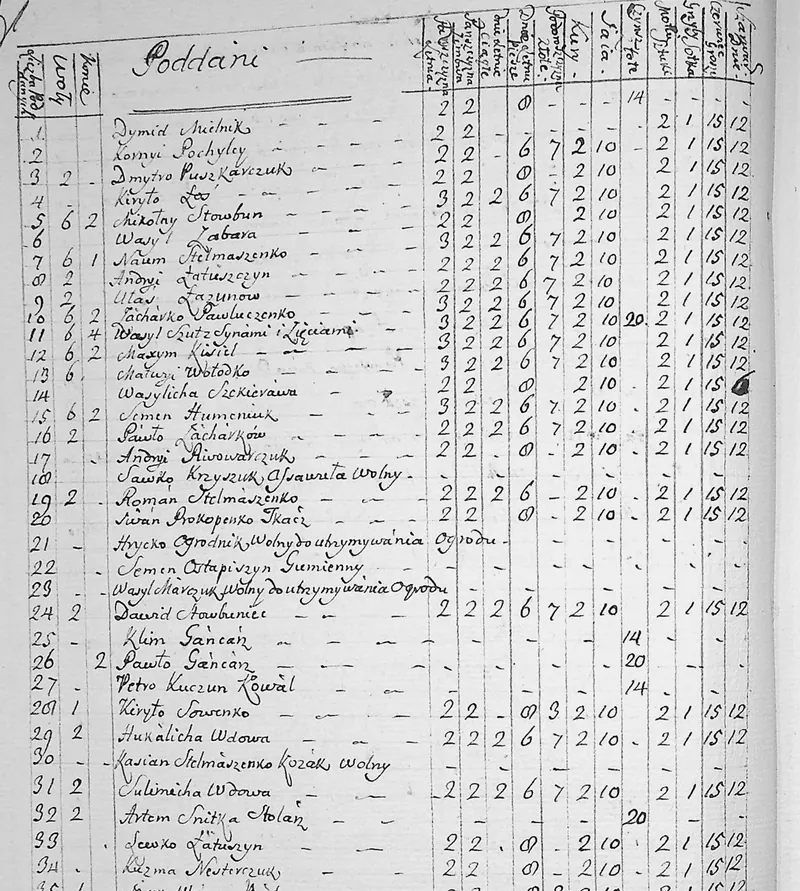
On 1 December 1790 the estate was divided among the sons, and each share was described name by name: 132 peasant households and 66 noblemen — with their livestock, labour dues, dues in kind and rent.
The 1794 inventory adds the trades: a blacksmith, weavers, a joiner, a threshing-floor overseer. The inn is kept by Moshko Hershonovych. And the garden has its own gardener — «Hrycko Ogrodnik, wolny do utrzymywania Ogrodu», free of other duties so that he can look after the garden. In the 1790 list he stands at No. 25.
What the researcher gained
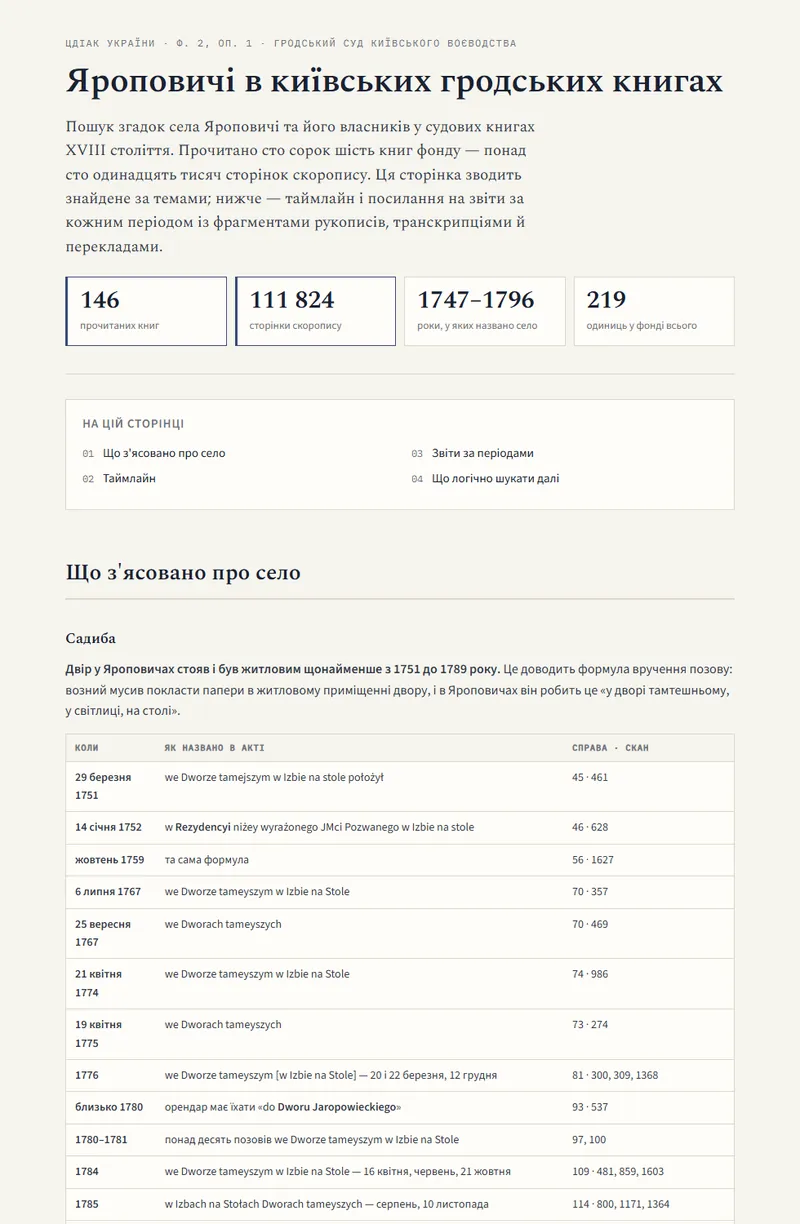
- What has been established about the village — by topic: the manor, the owners, documents drawn up in the village, the church, the people, boundaries, farming and taxes
- A timeline for 1747–1796 — about forty milestones
- Reports on nine periods with fragments of the manuscript, transcriptions and translations — 170 fragments
- Lists of the subjects by name for 1790 and 1794
- What makes sense to look for next
The manor house is coming back to life today
How the manor house in Yaropovychi is being restored — on its Facebook page.
How much work it took
- 146
- books read
- 111 824
- pages
- 676
- mentions of the village brought together
- 170
- manuscript fragments in the report